Enact Brahmins (Prevention of Atrocities) Act
Stop hate speech targeting Brahmins- Brahmophobia
To review the petition in saptharishi.org website and to sign the petition, please click the link below.
The goal of Brahmin Hate Propaganda is Annihilation of Bharatiya Civilisation and Extinction of Hindus.
Brahmins just happen to be in the way and will be massacred first.
Now available for ordering Amazon India estore
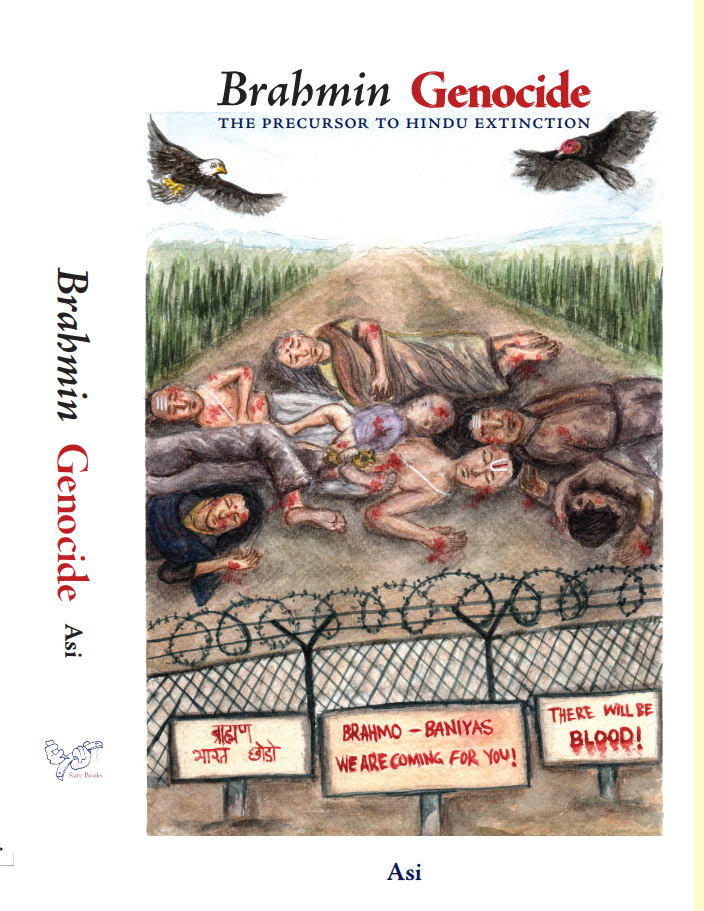
Brahmin Genocide describes the fight for the survival of the Bharatiya Civilisation, arguably the only surviving link to the primordial.
The book informs the challenges faced by the Brahmin community, who have been unwittingly drawn to the frontline of a civilisational battle.
Many Brahmins are unaware of their presence in this battlefield and are busy with their daily lives, oblivious to the potential dangers to them and their loved ones.
The present work explicates the colonial origins of the Brahmin hate narrative, amplified and spread today as globally visible Brahmin hate propaganda.
Global Brahmin hate often masquerades as the ‘caste privilege’ narrative.
The inevitable consequence of Brahmin hate propaganda is Brahmin Genocide, the latest example being Kashmir.
The objective of Brahmin hate is Hindu civilisational extinction. Brahmins just happen to be in the way.
An outline of a battle plan for the Brahmin community and Sanatanis engaged in this civilisational battle is presented in this book.
Brahmin Genocide is meant for all Indians and well-wishers of Bharatiya civilisation who see it as a beacon of hope, a guide for a sustainable, harmonious and equitable modernity—and as a symbol of triumph of human civilisation.

It is extremely important to recognise the following: If the Brahmins of today fail to emulate the Brahmins of the Vedic Period, Brahmanatva will not survive.
Padma Bhushan Dr. S.L. Bhyrappa, Eminent novelist and author.Why is it important to address this issue of Brahmin hate speech?
Brahmophobia and anti-Brahminism are unique and dangerous, because they are often ignored by most democratic institutions and even supported by sections of mainstream media and civil society. For example, when it comes to incidences of terrorism, while condemning such incidents various democratic institutions, media, politicians and others emphasise that these are misguided individual acts and terrorism has no religion. However, exactly opposite views gets peddled in the case of Brahmophobia. Even something not caused by or connected with Brahmins gets described as “Brahminism” or “Brahminical” and often Brahmins are criticized for it. Just as associating a religion with a terrorist act is called out as bigotry, associating a community with individual actions or negatively stereotyping the entire community should also be called out as bigotry. There cannot be different yardsticks to measure bigotry. Bigotry and hate speech in any form directed against any group, community or religion should be unequivocally condemned.


Research studies conducted on genocides identify distinct stages of the process before mass killings begin. Eight stages of genocide were first identified in 1996 by Dr. Greg Stanton, of the US Department of state. (which was later modified to 10 stages). In a briefing paper titled “the 8 stages of genocide” presented to the United States Department of State, Dr. Stanton presents the long term play out of genocide that develops in eight stages that are “predictable but not inexorable”. In 2012, he added two stages, Discrimination and Persecution, which resulted in a 10-stage model of genocide. The 10 stages are Classification, Symbolisation, Discrimination, Dehumanisation, Organisation, Polarisation, Preparation, Persecution, Extermination, Denial.
Classification refers to distinguishing by race, nationality, ethnicity, or region. Classification is a method of dividing the society and creating a power narrative(struggle) between groups. Symbolisation refers to the “calling out” of names, languages, type of dress and similar. In the Discrimination stage, a dominant group uses law, custom, and political power to deny the rights to other groups. The dominant group is driven by an exclusionary ideology that would deprive less powerful groups of their rights.. It legitimizes the victimisation of weaker groups. Dehumanisation is the next stage wherein one group makes another group seem inhuman. This is an important stage as this prepares the ground for overcoming a human being’s normal aversion to murder. The victim is no longer seen as a human being in the eyes of the potential murderer. The next stage is organisation wherein the group gets organised to commit mass murders. In the Polarisation stage, hate groups broadcast hate propaganda and mainstream politicians, civil society are rendered silent by threats, intimidation. In this stage, attacks are staged and subsequently blamed on targeted groups. Next is Preparation wherein target groups are forced to wear identifying symbols and segregated into ghettos or forced into concentration camps. The last 3 stages are persecution, extermination, denial. It must be emphasised here that the process is not sequential. Logically, later stages must be preceded by the earlier stages. In reality all stages continue to operate throughout the process.
| Genocide Stage | Characteristic | Relevance to Brahmin Hate |
|---|---|---|
| Classification | There is a division of “us” and ‘them’ typically carried out using stereotypes | Brahmins are called as ‘invader Aryans”, the outsiders who came from outside of India and have no right to live in India. |
| Symbolisation | There is visual manifestation of hatred | Brahmins are mocked by the symbolism of their attire, appearance, language |
| Discrimination | The dominant group denies civil rights to identified groups | In some states, there are ‘non Brahmin’ movements with a stated agenda to polarise the rest of Indians against Brahmins. |
| Dehumanisation | Targeted groups are treated with no forms of human rights or personal dignity | Brahmins are often mocked as ‘pigs’, ‘pests’, their sacred symbols are also mocked |
| Organisation | Regimes of hatred often train those who go on to carry out the destruction of targeted people | Brahmin hate propaganda is well-funded. Well-trained resources are utilised to carry out full-fledged hate campaigns. |
| Polarisation | Propaganda begins to be spread by hate groups | Multiple groups/social media handles are actively propagating Brahmin hate |
| Preparation | Perpetrators plan the genocide. They often use euphemisms to cloak their intentions | There have been explicit calls for genocide of Brahmins. Also targeted attacks on Brahmin community are being carried out |
| Persecution | Victims are identified because of their ethnicity or religion and death lists are drawn up. | In Kashmir, a systematic identification of Kashmiri Pandit families and their property was done and the pandit families were ordered to either leave the valley or face death. |
| Extermination | Hate groups murder their identified victims in a deliberate and systematic campaign of violence. | In Kashmir, many members of the Pandit community were murdered in cold blood, for the only reason of them being born as Kashmiri Pandits |
| Denial | The perpetrators or later generations deny the existence of any crime. Evidence is destroyed and witnesses are intimidated. | Many perpetrators of Kashmir ethnic cleansing are roaming free even today, without any punishment. Some sections of media are resorting to whitewashing this ethnic cleansing. Some of them even portray the terrorists as ‘innocent victims’. |

1 The Battlefield & Opponents
2 Hate Speech, Brahmophobia and Mainstream Media
3 Brahmophobia and its Consequences
4 Brahmophobia : Techniques
5 Everyday Brahmophobia
6 Managing Everyday Encounters
7 The Road to Global Brahmin Genocide
8 Sources of Brahmophobia
9 Fake Narrative - Brahmin Monopoly in Education
10 Racist Aryan Invasion Theory
11 Brahmophobia & the Indian Diaspora Communities
12 Kashmiri Pandit Genocide
13 Cricket, Mainstream Media and Brahmophobia
14 Role of Brahmins in a New World Order
15 Brahmophobia -a Legal Perspective
We welcome your contribution to this Dharmic effort. Our bank account details are given below. We can accept money only in Indian rupees and within India. As per Government rules, we are NOT in a position to accept any donations from outside of India .(Foreign donations)
We request you to send an email to donations@saptharishi.org with your transaction details and your address, so that receipts can be issued.
As per government rules, for donations above Rs. 50,000, please provide PAN number details.